Sunday, 16 February 2020

                             Maintaining the perfect technique is everything.


As a jump specialist, I've been watching in detail how Mondo Duplantis did not stop at 6.17m, he came right back and broke his own pole vault world record by clearing 6.18m!


You don't have to be a specialist to be able to see clearly, the magnificent quality of his technique.
First, if we look at his approach, we can see how during it, he keeps his knees at 90 degrees, and how he gradually increases his speed to reach the maximum to guarantee an explosive take off, and at the same time to obtain a great amplitude at the entry. The rest is pure, good quality gymnastics, of perfect abilities.

The speed was great, but there is something that impressed me a lot- the ability during the approach, to keep his hips always up, something that triple jumpers almost always have problems with.
For example, during the hop and the step, triple jumpers due to lack of technique, tend to drop the hip at these two jumps.

Committing this error results in the loss of momentum and the speed between jumps, resulting in the last jump being almost always very poor.

In these last three years, despite the fact that the 18m barrier has been passed several times, the technique of jumpers remains the same, and I personally have not seen any change.
I think we, as coaches, are forgetting about the important upright posture which a triple jumper has to keep during the jumps.

Another very fundamental thing- jumpers still do not know how, during the approach, to be able to push back on the track or the take-off board.
Maintaining the speed between jumps is the most important thing for achieving a great distance, but the complexity of this discipline makes everything difficult, so everything has to be in balance.
For example, I will discuss some of the things we have to take into account - remember each coach knows what to focus on with their athletes,

- Speed
- Time and space.
- Posture
- Co-ordination etc.

To be a great triple jumper you have to work on the technique day by day. Plyometrics is very important, but an athlete without technique, no matter how strong or fast he will only accumulate injuries instead of developing his results, and when for one reason or another he becomes professional, his career will be damaged due to the great lack of technique.


Sunday, 20 January 2019

"How to become a Triple Jumper"


Many athletes in the world choose Triple Jump because they are strong and have great speed. Others because apparently, they have done a triple jump competition and the result was so impressive that they are selected to became a triple jump athlete. Some of these reach the second level and some may reach the elite level, but at what cost?

We are in 2019, in the 21st Century and many coaches make the same mistakes when it comes to training someone for Triple Jump or Long Jump. For example, we use the same training program for everybody, when we know that each athlete has a different body composition, resulting in different levels of progress, despite using the same program.  As a coach, you have to have the ability to tailor the programme to each individual athlete, being inventive with new jumps exercises which will improve the suppleness and agility of the jumper even more.

One of the other big issues of a triple jumper is how to work with time and space between the jumps.
What is Time and Space? It is what gives the athlete the ability to know when he or she achieves e.g a hop of 6m, a step of 5.5m and a final jump of 6m ( these numbers I'm saying are hypothetically).
If you chose an athlete to become a triple jumper, and I am talking about both genders, the first thing you have to do is teach them the basics of this discipline. It's a shame that many coaches only focus on having results, and they forget to work hard on the basis. Worst of all ,many believe that the basis is only trained in the preparation phase, and they do not use it anymore during the year - this is a big mistake.

The BASICS in triple jump, teach the athlete the correct form to improve each exercise, such as coordination, time and space, balance, how to push the track during the approach etc. A good base prevents risk of injury and maintains healthy physical condition of the jumper.

The BASICS exercises are something that any athlete has to keep doing for life, even if they are a professional jumper. Working on the basis of this discipline will always keep the technique of the athlete polished and the facility to improve every training   
Another problem is how many times you train in a week. It is impossible to achieve something, only training for 1 hour, once or twice per week.

The warm up alone takes almost 45min, so when you start the real training you don`t have enough time to accomplish a good training session. In Europe, I can still observe athletes starting to do real jumps without a proper warmup and without a good technique - it scares me when I see the coach pushing them for better results under these circumstances.

Triple jump is a hard discipline to practice, that's why you see that there are very few who keep jumping over the 17m + in men and over the 14.50m + women, but when you work well at the base of this discipline, you will create of a talented and great jumper.

If you only train 1 hour or 2 hours per week, that means that the work on the BASIS will be poor, and if your coach is someone that doesn’t have too much experience in this discipline, then as an athlete you are wasting your time and you will risk injury and disappointment.   


Monday, 19 November 2018

Scientists reveal triple jumpers are the ultimate Olympians - and even develop 'superskeletons' to jump further


Athletes exert a force 22 times their body in the hop and step phases
Their bones are stronger and their thigh and shin bones become thicker
Fastest men and women hit the board around 10.5 and 9.5m per second
Most men have adopted 'double arm shift' to propel themselves farther.


No athletes arguably embody Pierre de Coubertin's Olympic motto – 'faster, higher, stronger' – more fully than those competing in the triple jump.
This dynamic track and field event comprises an approach run, followed by three consecutive phases: the hop, step and jump.
The winner is the athlete whose rearmost mark in the sand is furthest from the takeoff board.
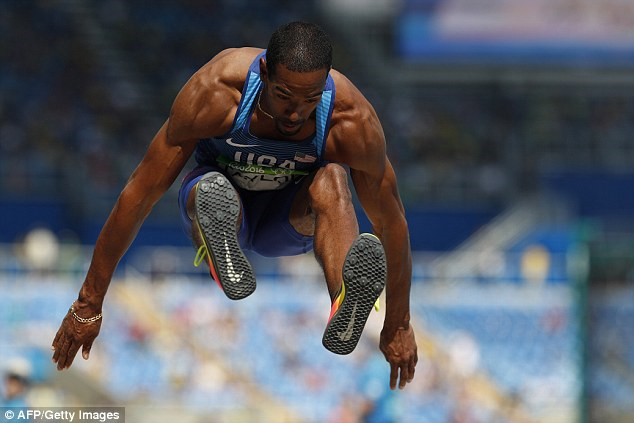
No athletes arguably embody Pierre de Coubertin's Olympic motto – 'faster, higher, stronger' – more fully than those competing in the triple jump. This dynamic track and field event comprises an approach run, followed by three consecutive phases: the hop, step and jump. Pictured is Christian Taylor who took home the gold in the men's triple jump in Rio
WHAT MAKES THE PERFECT TRIPLE JUMPER?
A researcher at Loughborough University explains that the landing between the hop and step phases, while an athlete is competing in the triple jump, can produce a force that is 22 times their body weight.
In order to endure such force, the bones of these athletes have to be much stronger than the average person.
In addition to being incredibly strong, triple jumpers must also be very fast; the fastest athletes in the men's and women's events will hit the takeoff board at around 10.5 and 9.5 metres per second respectively. 
The also be cable of jumping higher in the air, as the higher you jump the further you will travel. 
Research has shown that, at the landing between the hop and step phases, the force exerted by the athlete on the ground can be up to 22 times their body weight: imagine an athlete of 80kg briefly weighing 1.7 tonnes, and having to stand on one leg.
This is the highest measured force that a human limb is exposed to during any intentional activity (so not including accidents such as car crashes).
For this reason, triple jumpers have stronger bones than normal people; in fact, their thigh and shin bones become thicker and denser in order to withstand the huge forces that they must undergo during the event.
In addition to being incredibly strong, triple jumpers must also be very fast; the fastest athletes in the men's and women's events will hit the takeoff board at around 10.5 and 9.5 metres per second respectively.
These speeds are similar to those that will be seen in the long jump finals.
In fact, it was calculated that the longest hop phase ever measured in the triple jump (7.02 metres by Kenny Harrison of the USA) would have been equivalent to a jump of 8.29 metres had he landed in the style of a long jump.
This would have been enough to win him the silver medal in the long jump at London 2012 – but in the triple jump, he simply landed on one leg and carried on.


Research has shown that, at the landing between the hop and step phases, the force exerted by the athlete on the ground can be up to 22 times their body weight. Caterine Ibarguen (pictured) won the gold with a 14.52m triple jump
Physics dictates that the higher in the air an athlete travels, the further they will jump – provided they don't sacrifice their speed.
So, the athlete needs to carefully balance the speed and the height of their jump, in order to perform really well.
Because of this, technique is an extremely important aspect of the triple jump.
This involves a symmetrical swinging of both arms back and forth during each phase, rather than the asymmetrical arm swings used during running and walking.
One of the benefits of this technique is that it allows athletes to spend longer applying force to the ground and therefore to propel themselves higher into the air.
Computer simulations of triple jumping have indicated that this double arm technique is optimal, and indeed most male triple jumpers now use it.
The 'double arm shift' is not easy to perform; the triple jump is a delicate balancing act – athletes need to maintain their stability while undergoing huge stresses and strains, and all during ground contacts of only one to two tenths of a second.
The slightest mistake, and the jump will end in failure.
Very few women athletes use this technique in competition – but if they are to challenge Inessa Kravets' world record of 15.50 metres, also set back in 1995, they may need to adopt it.
As well as the movement of the arms, the proportion of the total jump distance made up by each phase is also considered to be an important factor in the triple jump.
Typically, the step is the shortest phase, making up around 30% of the total distance.
RESEARCHERS SUPPORT CASTER SEMANYA AND OTHER WOMEN LIKE HER
As the prestige of international athletics grew during the 20th century, critics worried that male athletes might commit 'gender fraud' in pursuit of sporting glory. 
In the 1940s female Olympians were forced to participate in medial exams and provide records to verify their that they were women.

In addition to being incredibly strong, triple jumpers must also be very fast; the fastest athletes in the men's and women's events will hit the takeoff board at around 10.5 and 9.5 metres per second respectively. Although not a triple jumper, Caster Semanya (pictured) has extra levels of testosterone that may contribute to her ability to perform
Many unnamed female athletes have been dismissed from the sport and banned from competing due to predispositions such as higher levels of testosterone or an extra  chromosome.
Experts argue that there has been no limit set on testosterone levels in men and male competitors are allowed to increase their levels if found to be much lower than the average.
They can apply for a 'Therapeutic Use Exemption' that allows them to take medically prescribed steroids to augment their androgen levels.
Researchers also say that the Olympics are built on the back of inequality.
Wealthy, powerful countries dominate the Olympic Games, while conflicted, war-torn, impoverished countries simply lack the resources to promote sport to the level that will produce Olympic champions. 
Then athletes either distribute their efforts evenly in the hop and jump – what's called 'a balanced technique' – or they choose a hop or jump-dominant technique, where one of these phases is substantially longer than the other.
Recent computer simulation studies indicated that balanced or hop-dominant techniques may be optimal, but the current men's Olympic champion Christian Taylor – who came very close to beating Edwards' world record last year typically employs a jump-dominant technique.
Whichever method competitors deploy at Rio 2016, there's no doubt they've been training to run faster, leap higher, and be stronger than ever before.
And in that sense, maybe they really are the ultimate Olympians.
Sam Allen, Lecturer in Biomechanics, Loughborough University
This article was originally published on The Conversation. Read the original article.
https://youtu.be/rjT_JwRi0oA

Sunday, 17 June 2018

Rhythm and speed for jumpers

Hi Guys- I haven’t had time to write updates in my blog over the past few months, as I’ve been so busy with my coaching commitments, but I’m now going to make every effort to write an update every month, for those of you who have been making enquiries.

Rhythm and speed has to be in perfect balance for any jumpers, especially for long and triple jump. Although long jump is formed by an approach followed by a takeoff, it doesn’t mean that the athlete doesn’t need to have a rhythm- on the contrary, to have a perfect rhythm make the athlete have a perfect takeoff, and good control in the flight phase at the moment of the jump. Also to have a good rhythm, the athlete will have a perfect speed control for the approach. This combination between the speed and rhythm is the most important thing in the technical part of the jump.
For Triple jump, it is even more complicated, as this discipline is composed of approach, hop-step and jump. Here the rhythm and speed have to be almost perfect, as after the approach, the athlete has to realize 3 perfect horizontal jumps, and each of them is destined to gain distance.
They are many exercises to improve rhythm, and you can use from simple to really advanced exercises. The most important thing is to work continuously every day to improve the technique to perfection.
Good rhythms make the athlete have greater suppleness and mobility in each technical movement. If you look at the 8.83m from the Cuban Long jumper Juan Miguel Hechabarria, you can see clearly how perfect he is working with the speed and rhythm, and also his technique in the air is completely perfect.
What could you do to improve rhythm?

Variations of exercises with hurdles from lower to high level, coordination run techniques with cones, plyometric with light weights , exercises with continuous short jumps to train your mind for exactitudes etc.  They are many exercises that you can use, but to improve your technique, you need specific exercises designed for each individual athlete.    


Thursday, 19 October 2017

Flexibility & Core


 The old season is the phase when the athlete has to prepare strongly physically and mentally, and it is the stage which the training programs have to be perfectly organized for the athletes. In recent months I have been conducting an investigation on how to carry out a training program that develops a better result for the athlete. To achieve my goal I did an investigation in different countries and at the same time analyzed many training programmes of  some top, and ex top athletes in long and triple jump.

I found that each one of them has different training plans, but the exercises are the same, and most of them work with exercises such as these:

Hip stability,
Strength
Explosive power
Muscular and Cardio vascular endurance 
Explosive hip recruitment
Dynamic flexibility
Foot speed
Core

Now, when it comes to working flexibility, it surprised me that most of the athletes and also some coaches think that working flexibility removes explosiveness for jumps. I really don`t understand where that came from, because the effects of poor flexibility will cause a decrease in athletic performance. In order to perform optimally, the body must function correctly. Proper function begins with a comprehensive flexibility program. Flexibility training is beneficial for many reasons including:
Helping to correct muscle imbalances
-          Increasing the range of motion of joints
-          Decreasing excessive muscle tension caused by shortened muscles
-          Relieving stress placed on joints caused altered muscle length
-          Improving the health of the musculotendinous junction
-          Helping to maintain normal functional length of muscles
-          Improving the efficiency of the neuromuscular system
-          Improving overall bodily function
-           
Every Coach knows what an athlete has to have to be a good triple jumper, for example coordination, rhythm, balance, sense of time and space and explosive reaction.  When an athlete is flexible, it is even easier to work plyometrics exercises, but also do more fluently the special gymnastic exercises for triple jump.  

The other thing that surprised me, when have work on core stability, everyone does the same exercises and many of them think that Core is only to perform abdominal exercises and work with medicinal balls.
If we look at the posture which a triple jumper has to maintain during jumps, the position of the hip, the coordination that  he has to have between the arms and legs, and not forgetting the  impact that the legs have to absorb on each jump, it is crazy to think that just sit-ups, and work with medicine ball will develop the results of the jumper. There are many special Core exercises for triple jumpers, but it is a shame to see the lack of inventiveness of some coaches to create specific exercises for each of the athletes.

It is a pity to see many jumpers  training very hard, but with poor competition results, and  also to see how many times athletes try to copy exercises from other athletes, thinking that it is going to be perfect for them. When an athlete gets to the level that he has to look to strangers  for help ,this must  mean that there is something wrong between him and his coach. They should try to analyze with their coach what is going on, and try to find a solution which, instead of worsening the situation, bring progress in the results of the athlete

Friday, 18 August 2017

World Championships London 2017

The world championships are over, with a lot of surprises in almost all events, but I want to talk specifically about long jump and triple jump. In my opinion South Africa is going in a good direction in long jump- they brought two athletes and both won medals, gold and bronze.  Luvo Manyonga jumped 8.48m, but to me this guy can jump very easily over 8.60-8.70m. He still has to work to clean and improve his technique, but he is a talented athlete, hungry to jump as far as possible and I think that it is something that he can work on really easily. Triple jump was a great battle between Taylor and Claye, both good athletes, but I think Christian Taylor is pushing too much for the world record. He has the record under his foot and it is just a matter of time - the record will come when he least expects it.

All the athletes played a good role, they did everything possible to obtain a medal and that's something we have to be proud of in all of them. We also have to be proud of those athletes who tried to qualify for the world championships and for one reason or another they did not make it.
Triple jump is a difficult discipline for men and women, and apart from that, even having talent may not be enough to be a great athlete. You have to train hard and smart, but above all you have to have a good coach with sufficient knowledge about this discipline, someone who believes in you, understands you and who will be able, with patience to lead you to obtain great results.

I live in London and I was really disappointed when I did not see any British athletes in Long Jump (male) and just one athlete in Triple Jump that even did not make the qualification for the final. There were no British athletes in the Female Triple Jump either and although they had 3 female athletes in long jump, the results were not good, and not what they expected.  I wonder what is happening here in the UK with the jumps discipline- disappointingly low achievement levels from the country that has provided the world record of triple jump. You would imagine that here they would be able to produce greater jumpers, so what is going on? Could it be lack of investment, problems with the coaching system? If anyone can suggest reasons behind this situation, I’d welcome their ideas.

Although I am not her coach I would like to talk about a long jump athlete (Jazmin Sawyers).  I have seen her compete on more than three occasions. The last time I saw her jump was at the Olympics in Rio, but when I saw her again in London I was really surprised that after five years she still has the same technical problems.  I heard that she changed her coach, but for me when you take the decision to change coach, you do it to improve. Although many times, when changing to a new coach, it can be some time before seeing the results, but 5 years with the same problems, that is something that I cannot understand. She is a great talent, available to reach the 7+m if she improves her technique.

I think that in general, the team GB did a good job- they have a lot of young talented athletes ready for the new season, and prepared to compete with top of top from the world.  I look forward to seeing their future in athletics unfold.


Saturday, 29 July 2017

Why it is so difficult to improve on Triple jump distance in Europe?

People keep asking me the same question every time- why is it so difficult to improve distance in triple jump when they train 5 days a week and they train really hard?
I had been doing research in different European countries about why it is so difficult for a woman to jump even over 13.50 and the men 16 or 16.50m.

Triple jump is not an easy athletics discipline, therefore a good training program guided by a coach with extensive knowledge specialized in triple jump is fundamentally necessary.
Although in Europe there are good coaches specialized in this discipline, there is a lack of practical knowledge and experience amongst some of them.

When a coach selects an athlete to be a jumper, the first thing to do is start working with the special triple jump base. When I talk about the base, I am talking about to improving development and the quality of athlete through special exercises such as those shown in the examples below;
Here I want to give you an example of what you can do to work with your athletes. Remember as a coach you have to make your own training program for each athlete.

1-      To improve coordination, rhythm and explosiveness, exercises between high and low hurdle,
2-      To improve distance, series of jumps uphill, also exercises between hurdles and cones with different distances
3-      To improve time and space, series of jumps down hill
4-      To improve reaction time, box plyometric (statics)
5-      To improve the speed between the jumps, box plyometric exercises with speed. (plyometric speed has to be made also on the track so fast as you can but with rhythms)

There are so many exercises you can use but it is up to you to look for those that they are suitable for the athlete.         
 
I want to explain to you that before the athlete starts working with those exercises, to avoid injury the athlete has to work with different exercises to strengthen the ankles, knees and natural physical strength. This work should be performed in different types of surfaces like grass, sand, tarmac and pavement (exercise on pavement can only be done under an experienced coach)
It is also very important to work with gymnastic exercises to improve the posture of the athlete as well as the positions of the legs in each flight phase.

Something very important that has to be in every training program of each athlete, is the continuous work of core exercises with medicine balls and others equipment for strengthening the hips and body stability and a special weight circuit for triple jump, done in the weight room.

I hope this information has been of help, and if any of you have any questions, please let me know.